
The Science of Myopia Control: How MiSight® 1 Day Soft Contact Lenses Protect Growing Eyes
Myopia, commonly known as nearsightedness, has historically been treated as a simple inconvenience—a issue resolved by getting stronger glasses every year. However, progressive myopia in children is actually caused by the physical lengthening of the eyeball, known as axial elongation. The longer the eye grows, the higher the risk of sight-threatening eye diseases in adulthood, including retinal detachment, glaucoma, and myopic maculopathy.
MiSight® 1 day by CooperVision is the first soft contact lens cleared by the FDA to slow the progression of myopia in age-appropriate children (initially prescribed between ages 8 and 12).
How MiSight Works: The Optical Mechanism
Traditional single-vision glasses and contact lenses direct light straight to the center of the retina (the fovea), providing crisp central vision. However, single-vision lenses project light slightly behind the peripheral retina. This phenomenon, called peripheral hyperopic defocus, sends a signal to the biological system that the eye needs to grow longer to catch up with the focal point.
MiSight lenses solve this problem using a proprietary optical design called ActivControl® Technology:
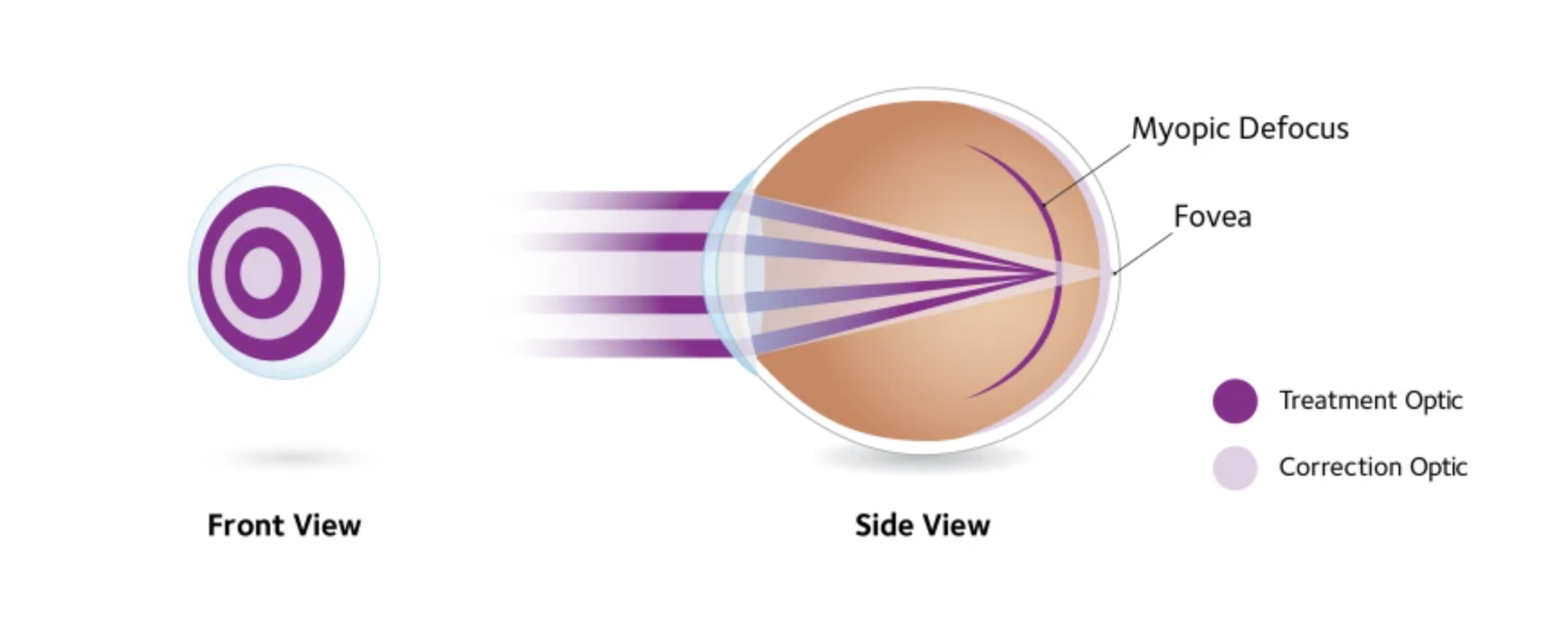
Concentric Dual-Focus Design: The lens consists of four alternating rings.
Correction Zones (2 zones): These focus light directly onto the retina to correct current nearsightedness and deliver sharp 20/20 distance vision.
Treatment Zones (2 zones): These add +2.00D of relative positive power, creating myopic defocus in front of the peripheral retina.
The "Stop Signal": By focusing peripheral light rays in front of the retina rather than behind it, the treatment zones act as a biological stop signal, directing the eye to slow down its rapid axial growth while keeping central vision perfectly clear.
Figure 1: Source - Coopervision
Proven Results from Long-Term Trials
The efficacy of MiSight is backed by one of the longest clinical studies ever conducted for a soft contact lens in pediatric myopia management.
Ease of Use & Child Safety
Parents often worry about whether young children can manage contact lenses. Clinical trial data showed:
Quick Adaptation: By 1 month of wear, 85% of children reported lens handling was easy, rising to 97% over the course of the study.
Hygiene & Safety: As a daily disposable lens, children wear a fresh pair every day and throw them away at night—eliminating lens cleaning, storage cases, and reducing infection risks.
Comfort & Vision: Over 90% of children preferred wearing their MiSight lenses over their standard spectacles for daily activities and sports.
Summary
MiSight 1 day lenses offer a proactive approach to myopia control. By utilizing dual-focus optics to alter peripheral light signals, they treat the root cause of progression—axial elongation—rather than simply correcting blurred vision. Starting treatment early helps safeguard children's sight for a lifetime.
What causes Myopia?

Genetics
Kids with one or two myopic parents are likely to be myopic.
Lifestyle
Kids who spend more time using handheld devices instead of spend time outdoors are more likely to become myopic.

Ortho-keratology orthok, ortho-k, atropine eye drops, soft multifocal contact lenses, Coopervision MiSight, Paragon CRT, Johnson & Johnson J&J Ability, FDA approved for myopia control, NaturalVue, Biofinity Multifocal, low dose atropine.
OUR UNIQUE SOLUTION
We can slow the progression of myopia with myopia managment using:
Eye Drops
Contact Lenses


Myopia is increasing at an alarming rate!

Atropine Eye Drops
Research has shown low-concentration atropine eye drops are highly effective at helping to stabilize myopia. These drops are taken just before bedtime to help minimize visual side effects.

Soft Contact Lenses
The FDA has approved specific soft contact lenses to slow the progression of myopia. These are worn during the daytime as a substitute for glasses. The FDA has approved soft lenses to help stabilize myopia.

Ortho-Keratology Contact Lenses
Ortho-keratology, also known as “Ortho-K”, lenses are worn during bedtime to correct vision as you sleep. These are hard contact lenses; also known as rigid gas permeable lenses “RGPs”. The FDA has approved Ortho-K lenses to help stabilize myopia.
Interested to learn more?
Contact us to setup a
Myopia Consultation
